
MOELLER MOLECULAR MODELING
STUDENTS PRESENT IN WASHINTON D.C.
<
In July 2011, science teacher Mr. Dan Shannon attended a conference hosted by 3D Molecular Designs at the Milwaukee School of Engineering in Milwaukee, Wisconsin. Everyone in attendance was a teacher, and the focus was on learning how to “tell the molecular story” of substances—from simple molecules like water to complex proteins. The idea was that storytelling through molecular models could engage students much more effectively than traditional lectures. At the end of the conference, the organizers invited teachers to form student teams at their respective schools to research a protein and present its story at a molecular biology conference.
Dan left the conference thinking, There’s no way this will work.
The following year, however, a friend he had met at the conference told him their team had become one of the most popular groups on campus. Students loved it, and they were preparing to present at a conference. His friend insisted, “You have to try it.”
So, in 2012, Dan started the Moeller team. In its first year, the team managed to 3D print a molecule. The next year, the students connected with a mentor at the University of Cincinnati College of Medicine but struggled to interpret scientific papers. They became frustrated and eventually quit. By the third year, they got started but didn’t finish the project.
Everything changed in 2015, the team’s fourth year, when Ben Hall ’18 joined as a freshman. The team scaled back its goals and entered the Science Olympiad Protein Modeling division. Ben placed third.
According to Dan, “Now, they were cooking.”
<
Soon after, the students found a mentor at the University of Dayton. The team 3D printed its molecule and wrote an abstract. In 2017, Ben, Jake Glass ’19, and Kyle Peters ’20—working with a researcher from the University of Cincinnati—learned enough about their molecule to tell its molecular story at the first of many international conferences the team would eventually attend.
Along the way, the students partnered with Mount Notre Dame High School to tell molecular stories. They also adopted the name Moeller Molecular Modeling or MO3. Since then, they have taken on a new project every year. One year, when the team consisted entirely of freshmen, its members chose a different approach. Instead of focusing on a single molecule, the students entered a national Molecular Video Challenge, telling the story of anxiety medications and how they interact with the GABA receptor.
The team meets after school, typically on Tuesdays and Thursdays for about 45 minutes. The only real requirement is that members are not afraid to learn.
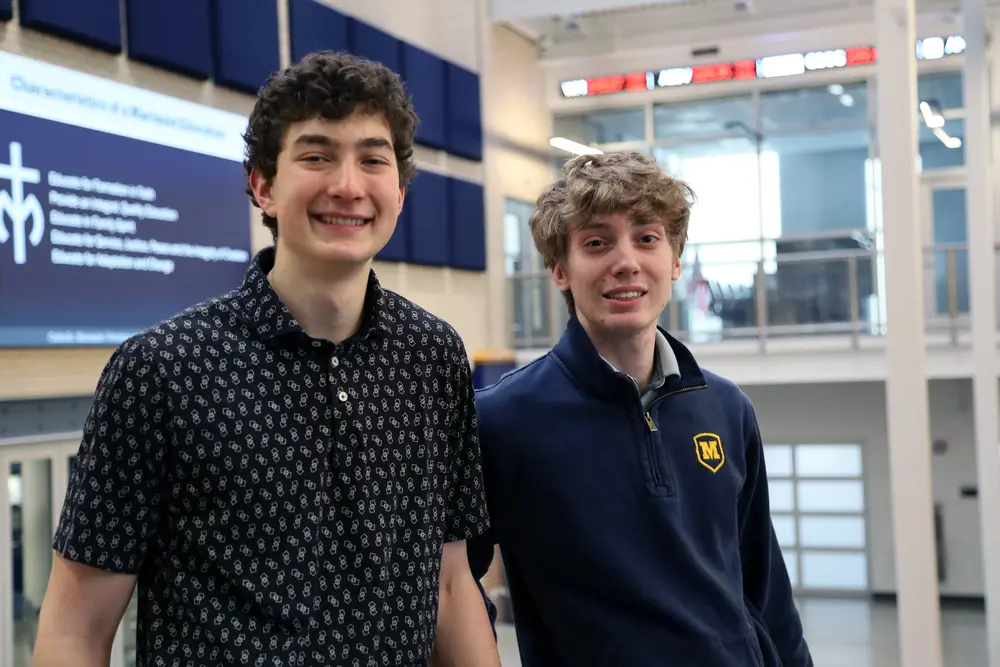
This past March, Noah Pitz ’27 and Scott Kaplan ’27 presented the molecular story of retatrutide at the American Society for Biochemistry and Molecular Biology (ASBMB) convention in Washington, D.C. Retatrutide performs the primary function of both Ozempic and Mounjaro, along with an additional fat-burning capability, and is currently in its testing phase.